
Defender for Cloud
- Which Defender plans are switched on
- Security contacts and alert notifications
- Automatic agent and vulnerability assessment settings
Free Azure security assessment
A storage account open to the internet or a database firewall that lets in everyone can sit unnoticed for years. We review your Azure subscriptions against recognised benchmarks and show you, in plain language, what to tighten first.
What we check
Every check looks at how things are configured, never at your data. Here's what each area covers.
Cost check
A VM that was shut down from inside Windows or Linux, rather than stopped in Azure, is still billed at its full hourly rate. Using the same read-only access, we list everything that's off or idle but still charging you, with an estimated monthly cost for each.
Standards
The report shows how many checks pass for each framework. It's a readiness view, not a certification or a full audit.
Read-only
You stay in control of access the whole time, and you can remove it whenever you like.
We email your administrator a short access pack with step-by-step instructions.
They run one script on a Windows PC and choose which subscriptions we may see. It grants the built-in Reader role plus three read-only directory permissions.
The script shows a short-lived secret once. Your administrator shares it with us by phone or a one-time secure link, and it expires within 14 days.
Your administrator removes all access with one command once the report is delivered.
What you receive
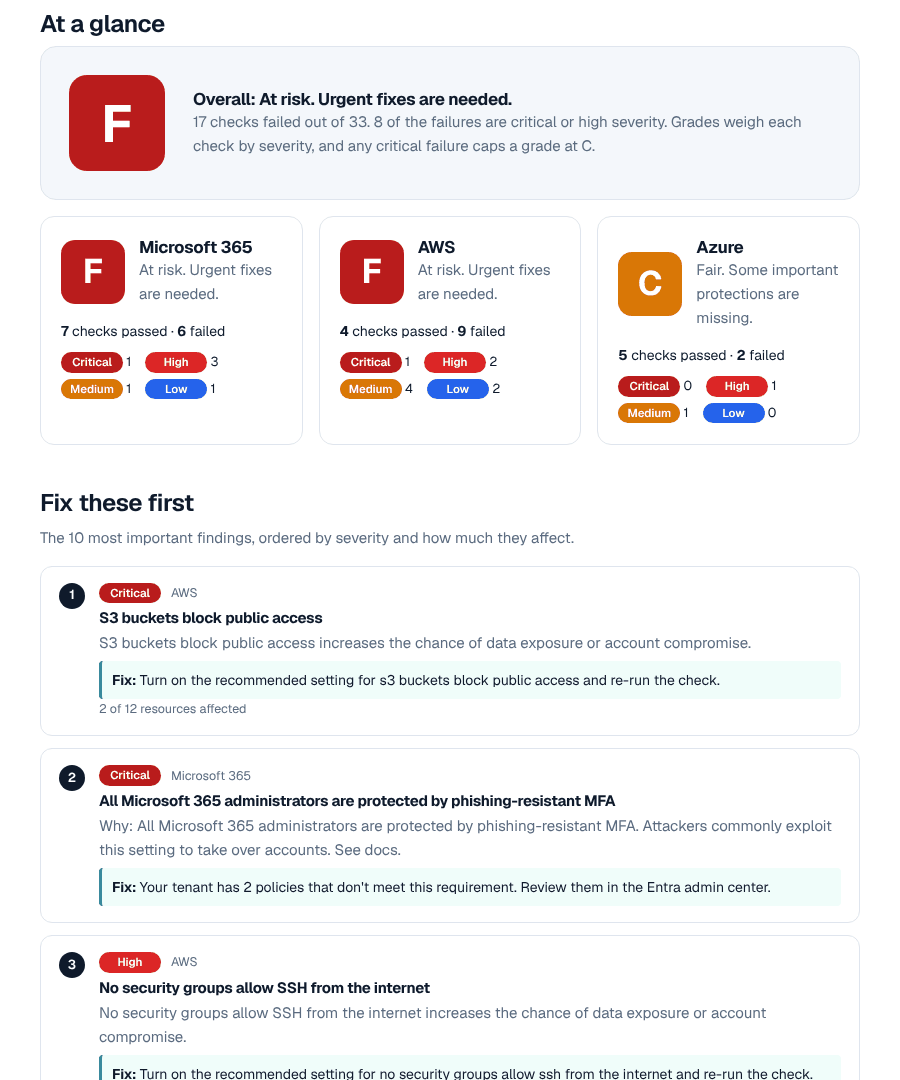
An A to F grade for each area, written for the person who signs the cheques, with the technical detail attached for whoever runs IT.
The ten findings that matter most, each explained in plain language: what it is, why it matters, and how to fix it.
How your settings line up against each framework we check, so you know where you stand before an audit or insurance renewal.
We go through the report with you on a call and answer questions. Any fixes are quoted at a fixed price, only if you want them.
Questions
Yes. The access we ask for can only read settings. It can't change anything, and it's limited to configuration, not your data. The section above lists exactly what we can and can't see.
No. We only read configuration through Azure's standard management APIs. Nothing is installed, and reads like these don't add noticeable cost.
Someone who is a Global Administrator and an Owner of the subscriptions to be reviewed. It takes about five minutes.
Yes. The setup script asks which subscriptions to include, and we only see those.
Yes. The same setup can cover both, and you get one combined report.
The assessment is free. If you'd like help fixing what we find, each fix is quoted at a fixed price before any work starts, and you're never obliged to go ahead.
Within two business days of your administrator finishing setup. We then book a 30-minute call to walk you through it.
Tell us a little about your setup and we'll send everything your administrator needs.